Wondering what separates the broke affiliate marketers from the ones making bank? It’s all about EPC.
EPC (Earnings Per Click) is simply how much money you pocket each time someone clicks your affiliate link. While rookies chase traffic numbers, the pros track this one metric religiously because it tells you exactly which campaigns are worth your time and which are draining your wallet.
This single number cuts through the hype and shows you the cold, hard truth about your affiliate business. Master it, and you’ll run campaigns the way the top affiliates do: based on data, not gut feel.
Jump to Section:
What is EPC in Affiliate Marketing?
EPC, or Earnings Per Click, represents the average revenue generated each time someone clicks on your affiliate link. This straightforward yet powerful metric reveals the true profitability of your affiliate marketing efforts at a glance.
EPC = Total Earnings ÷ Total Clicks
Example: If your affiliate promotions generated $500 in commissions from 1,000 clicks, your EPC would be $0.50.
What makes EPC particularly valuable is its versatility as a performance benchmark. Unlike conversion rate alone, EPC combines both conversion performance and commission value into a single, actionable metric. This allows you to effectively measure and compare:
- Individual affiliate program performance
- Traffic source quality and ROI
- Marketing channel effectiveness
- Landing page conversion efficiency
- Content type engagement and value
- Audience targeting precision
- Seasonal trends and promotional impact
- Overall campaign optimization opportunities
By tracking EPC consistently, you can quickly identify which elements of your affiliate strategy deliver the highest return on investment, allowing you to double down on winners and improve or eliminate underperformers.
How to Calculate the EPC in Affiliate Marketing?
Understanding your Earnings Per Click isn’t just useful, it’s essential for optimizing your affiliate marketing strategy. Fortunately, calculating this powerful metric is straightforward when you follow these steps:
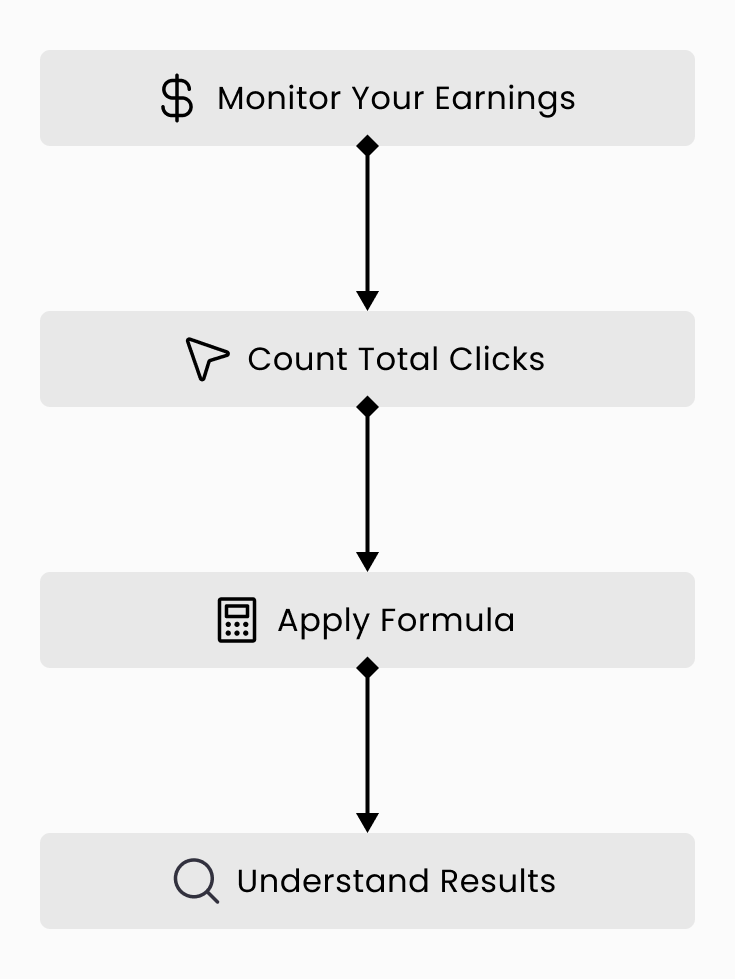
Steps to Calculate EPC
Calculating EPC is easy, but accurate tracking of your income and clicks is essential, especially when using reliable click tracking software to monitor campaign data and optimize performance. The following is a step-by-step guide:
- Monitor Your Earnings: First, locate the total commissions earned from all transactions or actions generated by your affiliate links. This includes all affiliate sales, leads, or any conversion that earns you money.
- Count Total Clicks: Second, add up the total clicks your affiliate links have received. This information should be available in your affiliate dashboard or tracking software.
- Apply the Formula: Use the simple EPC formula to calculate your earnings per click.
- What the Result Means: The EPC figure indicates how much money you make per click on average. If you made $1,000 from 10,000 clicks, your EPC would be $0.10, meaning you make 10 cents per click.
Calculating EPC is straightforward, but its value really becomes clear when you use it to diagnose campaign performance and spot improvement opportunities.
Whatever your goal, whether tracking performance on specific offers or comparing traffic sources, EPC is a reliable tool for making smarter decisions.
Why EPC Matters More Than You Think
EPC is not just a number. It’s a metric that reveals the real profitability of your affiliate marketing campaigns and helps you make smarter decisions with your budget.
Here are the key reasons why EPC deserves more attention than most affiliates give it:
1. Profitability Indicator
At its simplest, EPC measures the profitability of your affiliate campaigns. It lets you compare the revenue you’re earning per click against the cost of acquiring that traffic (Cost Per Click, or CPC).
Profitability Check: If your EPC is higher than your CPC, your campaigns are profitable. If it’s lower, you’re losing money on every click, which is a problem that compounds fast at scale.
Cost Efficiency: The EPC to CPC relationship shows how efficiently your ad spend is working. It tells you whether you’re getting a solid ROI or throwing money at traffic that isn’t converting.
2. Campaign Comparison Tool
EPC makes it easy to compare campaigns, products, and strategies on equal footing, regardless of traffic volume.
Apples-to-Apples Comparison: Two campaigns with different click volumes can still be compared directly by EPC. One with 10,000 clicks and one with 2,000 clicks are both comparable once you know how much each earns per click.
Better Resource Allocation: Knowing the EPC of each offer, channel, or product lets you put your budget where it actually performs, rather than spreading it thin across campaigns that look busy but don’t convert.
3. Network Selection Guide
Choosing the right affiliate programs is one of the highest-leverage decisions you’ll make. EPC helps you evaluate those choices with real data.
Analyzing Network Opportunities: Most affiliate networks show average EPCs for their offers. Use those numbers to shortlist programs before committing traffic. A strong average EPC signals that other affiliates are converting the offer successfully.
Direction of Your Strategy: A low EPC offer isn’t always worth the traffic investment, even if the commission looks attractive on paper. High-EPC opportunities let you focus your effort where the returns are strongest.
You can also use EPC to track seasonal variation, since some offers fluctuate based on demand at different times of year.
Evaluating EPC in Affiliate Marketing: Examples
EPC is an excellent metric for evaluating how well a particular affiliate campaign is performing. It allows you to assess the profitability of your campaigns and compare different marketing strategies. Here are a couple of examples to illustrate how EPC can be used for evaluation:
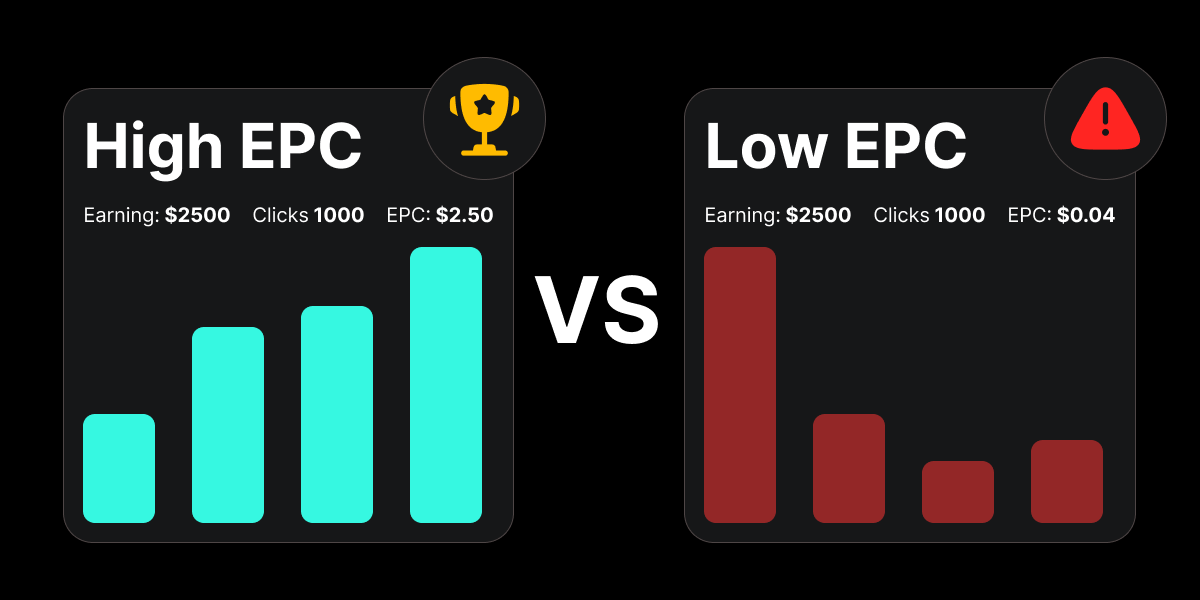
Illustration: EPC vs PPC – Understanding Profit Metrics
Let’s dive into concrete examples that illustrate how EPC illuminates affiliate campaign performance and guides optimization decisions. These scenarios demonstrate why this metric is essential for both diagnosing problems and identifying opportunities.
High-Performing EPC Campaign Analysis
⚠️ Common EPC Mistakes to Avoid:
- Chasing traffic volume without conversion focus
- Ignoring CPC while celebrating high EPC
- Overlooking mobile optimization
- Relying on low-commission affiliate offers
💡 Campaign: Premium Product Promotion
- 💰 Total Earnings: $2,500
- 👆 Total Clicks: 1,000
- 📈 EPC: $2.50
🔍 Why This EPC Is Outstanding:
- ✅ The offer likely has both a high conversion rate and a substantial commission value
- ✅ Your pre-click messaging accurately sets visitor expectations
- ✅ Your traffic is precisely targeted to qualified prospects
- ✅ The landing page effectively persuades visitors to convert
- ✅ The product’s price point and commission structure are favorable
Strategic Takeaway: This campaign deserves additional investment. Consider scaling your traffic sources or applying similar strategies to other affiliate offers.
Underperforming EPC Campaign Analysis
Campaign: Budget Product Promotion
- 💸 Total Earnings: $200
- 👉 Total Clicks: 5,000
- 📉 EPC: $0.04
🔍 Why This EPC Is Problematic:
- ❌ Low-converting offer or product with minimal market demand
- ❌ Poor alignment between visitor expectations and the actual offer
- ❌ Low-quality traffic from untargeted or unengaged sources
- ❌ Weak landing page that fails to persuade visitors
- ❌ Low commission rates relative to the required effort
- ❌ Technical issues in the conversion funnel
Strategic Takeaway: This campaign requires immediate intervention. Test a different traffic source or consider replacing this offer entirely.
Factors Influencing EPC
Your Earnings Per Click isn’t determined by chance. It’s shaped by specific variables you can actively optimize. Understanding these key influences lets you improve your affiliate marketing performance systematically rather than relying on guesswork. Here’s what truly moves the needle on your EPC:
1. Conversion Rate
The percentage of visitors who complete your desired action fundamentally drives your EPC. Higher conversion rates directly translate to higher earnings per click, creating a multiplier effect on your revenue. Industry research shows that even a modest 1% improvement in conversion rate can increase EPC by 20-30% in many affiliate verticals.
2. Offer Quality
The commission value and structure of your affiliate programs significantly impact your EPC. Higher-paying offers naturally boost your earnings per click, while recurring commission models can dramatically increase customer lifetime value. According to industry data, programs offering 30%+ commission rates generally produce EPCs 2-3 times higher than those paying under 10%.
3. Traffic Source
The caliber of your traffic dramatically influences EPC. Highly targeted, intent-driven visitors convert at substantially higher rates than random traffic. Studies consistently show that organic search traffic typically delivers 2-4 times higher EPC than general social media traffic due to stronger purchase intent.
4. Pre-Click Messaging
How you position offers before the click dramatically impacts post-click behavior. Clear, accurate messaging that properly sets visitor expectations leads to significantly higher conversion rates. Misleading claims might increase clicks initially but devastate your EPC through poor conversion performance.
5. Landing Page Effectiveness
The quality of the landing page experience often makes or breaks your EPC performance. Fast-loading pages with compelling copy, clear benefits, and streamlined purchase paths can double or triple conversion rates compared to cluttered, confusing alternatives.
6. Niche Selection
Certain niches inherently deliver higher EPCs due to product values, competition levels, and audience buying power. Finance, high-ticket B2B software, luxury goods, and specialized health products typically generate EPCs ranging from $1-$5+, while entertainment and low-cost consumer goods often hover below $0.50.
7. Audience Targeting
The relevance between your audience’s needs and the offers you promote creates the foundation for exceptional EPC. When your offer precisely addresses your audience’s pain points or desires, conversion rates naturally skyrocket. Market research shows relevance can improve EPCs by 400-500% compared to misaligned promotions.
By strategically optimizing these seven factors, you’ll systematically improve your EPC performance across campaigns. Small improvements across multiple factors compound fast. The difference between a $0.30 EPC and a $3.00+ EPC usually comes down to how well you execute across all of these fundamentals.
Calculating Net Profit Per Click
While EPC shows you how much revenue each click generates, smart affiliate marketers dig deeper to understand their true bottom line. Net Profit Per Click (NPPC) reveals the actual money you pocket after covering all your traffic costs.
Think of EPC as your gross income and NPPC as what’s left after expenses. This critical distinction separates struggling affiliates from those building sustainable businesses.
The calculation is straightforward:
NPPC = EPC – Cost Per Click (CPC)
Let’s break this down with a real-world example:
- Your EPC: $0.50 (you earn 50 cents per click)
- Your CPC: $0.30 (you spend 30 cents to get each click)
- Your NPPC: $0.50 – $0.30 = $0.20
This means you’re pocketing 20 cents in pure profit for every visitor you send to the offer. While that might seem small, it adds up quickly at scale. With 1,000 clicks daily, you’re looking at $200 in daily profit.
NPPC helps you make smarter decisions about:
- Traffic scaling – How aggressively you can afford to grow your campaigns
- Maximum bid limits – The absolute ceiling on what you can pay for traffic
- Campaign viability – Whether a campaign is worth continuing at all
Too many affiliates focus solely on EPC while ignoring their costs. They celebrate high EPCs without realizing they’re actually losing money after expenses. For paid traffic campaigns, maintaining a positive NPPC is non-negotiable unless you’re deliberately running a loss leader. Even a slightly negative NPPC can drain your budget surprisingly fast when scaled up.
Track your NPPC regularly across different traffic sources and offers. This single number tells you more about your affiliate business health than almost any other metric.
PPC vs. EPC
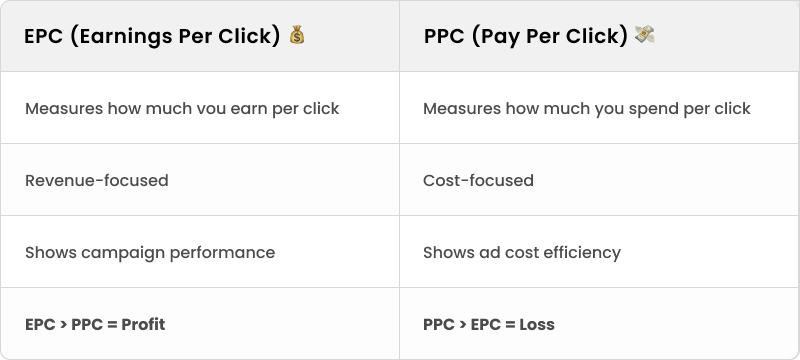
EPC vs PPC – The Differences
When running paid affiliate campaigns, two numbers determine success or failure: PPC and EPC. These metrics work together to reveal whether you’re making or losing money.
- PPC (Pay-Per-Click): This is what you pay for each visitor. Whether you’re buying Google Ads, Facebook traffic, or any other paid advertising, PPC represents your cost per click.
- EPC (Earnings Per Click): This is what you earn from each visitor after they click your affiliate link. It shows how effectively you’re monetizing your traffic.
The math is straightforward: When your EPC exceeds your PPC, you’re profitable. When your PPC exceeds your EPC, you’re losing money with every click you buy.
Example: If your PPC is $0.75 and your EPC is $1.20, you’re making $0.45 profit per click. If your PPC is $0.90 and your EPC is $0.60, you’re losing $0.30 per click.
This comparison gives you three clear options when campaigns aren’t profitable:
- Reduce your PPC: Negotiate better ad rates, improve quality scores, or find cheaper traffic sources
- Increase your EPC: Boost conversion rates, find higher-paying offers, or improve your pre-click messaging
- Cut your losses: Sometimes the smartest move is to abandon campaigns where the numbers don’t work
Many affiliates get trapped paying more for traffic than they earn back, continuing to run unprofitable campaigns and hoping things will turn around. Tracking these two metrics side-by-side for every campaign keeps you on the right side of that equation.
Strategic Campaign Selection
Choosing the right affiliate campaigns to promote is critical for maximizing EPC. One of the most effective ways to boost performance is by selecting high-paying affiliate programs that offer strong commission structures and proven conversion rates. Here are a few ways to improve your EPC through smarter campaign selection:
- Study High-EPC Offers: Find affiliate programs with a track record of strong EPCs. Most networks publish average EPC data on their offers, so use that to shortlist the ones worth your traffic.
- Test Multiple Offers: Don’t commit to one offer. Run several simultaneously, track their EPC, and cut the underperformers. The winner often isn’t the one with the highest commission rate.
- Target Relevant Offers: Make sure your offers match what your audience actually wants. Relevance drives conversion rates, and conversion rates drive EPC.
- Target High-Commission Offers: Higher commissions per sale or conversion naturally push your EPC up. All else being equal, a 40% commission beats a 10% commission every time.
4 Simple Ways to Improve Your Earnings Per Click (EPC)
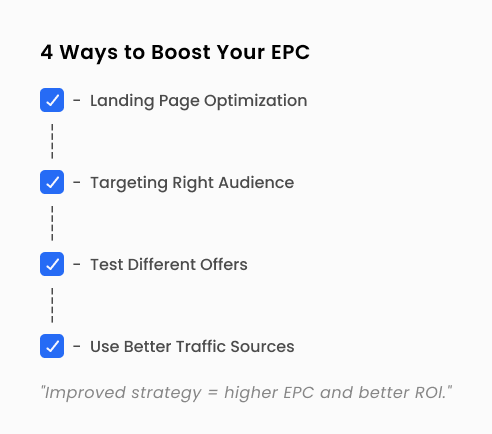
4 Ways To Improve Your EPC
There are four high-impact levers you can pull to push your EPC higher. None of them require more traffic. All of them require more precision.
1. Optimize Your Landing Pages
The landing page is where visitors decide whether to buy or bounce. Many affiliates unknowingly hurt their EPC by making landing page mistakes like poor mobile design, unclear CTAs, or slow load speeds.
After thousands of real-world tests, these adjustments consistently make the biggest difference:
Strategic Call-to-Action (CTA): Buttons work best when placed where eyes naturally look (slightly right of center) with colors that stand out from the rest of the page. Action-oriented wording creates urgency. “Get Your Discount Now” performs better than generic “Click Here.” One campaign saw conversion rates jump from 2.3% to 3.9% just by changing button text from “Submit” to “Claim Your Free Trial.”
Mobile-First Design: Most traffic comes from phones. Campaigns often fail when they look great on desktop but terrible on mobile. Buttons need to be thumb-sized, forms should be kept short, and pages must be tested across different devices. Fixing mobile issues has doubled conversion rates for many affiliates. A good landing page builder helps you quickly create responsive, high-converting pages without the technical headaches that often kill EPC.
Lightning-Fast Loading: Visitors abandon slow pages quickly. Large image files are often the culprit behind poor loading times. Compressing images, removing unnecessary plugins, and using content delivery networks for global audiences can save thousands in lost commissions. Each additional second of load time costs money.
Compelling, Benefit-Driven Copy: Effective copy focuses on what visitors want, not just product features. Answering “what’s in it for me?” from the visitor’s perspective drives conversions. Adding genuine testimonials has boosted campaigns by up to 27% overnight. The best copy explains specifically how products solve problems.
2. Target the Right Audience
Sending untargeted traffic is like pouring water into a leaky bucket. Many marketers waste months chasing traffic volume before realizing quality matters more.
Advanced Demographic and Behavioral Targeting: Looking beyond basic demographics produces better results. Combining multiple targeting factors works best, like reaching people who’ve recently searched for similar products and fall into specific income brackets. Weight loss affiliate offers often perform 3x better when targeted to people who’ve also purchased fitness equipment in the past 90 days.
High-Intent Keyword Optimization: Search terms reveal purchase readiness. Pages targeting phrases like “best [product] for [specific need]” or “[product] coupon codes” attract visitors ready to buy. Review pages focused on “best [product] for beginners” typically convert nearly 4x better than general information pages.
Strategic Audience Segmentation: Different audience segments respond to different approaches. Splitting traffic based on primary concerns and creating separate content for each group improves results. Software affiliate campaigns often see 40% higher conversions when creating different landing paths for price-conscious visitors versus feature-focused ones.
3. Test Different Offers and Affiliate Programs
Not all affiliate programs deliver equal results. Some generate significant revenue while others waste valuable time and traffic.
Systematic Offer Comparison: Testing multiple offers with the same traffic reveals surprising winners. Successful affiliates typically test at least 3 different products in any niche. Often, the best performer isn’t the one with the highest commission rate but the one with the best conversion rate. Tracking results in a simple spreadsheet shows which offers actually make money.
Network Diversification Strategy: Working with multiple networks provides security and options. Beyond commission rates, payment speed and tracking reliability matter tremendously. Many affiliates have lost significant revenue when networks experienced tracking issues. Those with solid technology infrastructure are invaluable partners.
Cross-Niche Profitability Analysis: Some niches naturally outperform others. Products that solve significant problems typically command better EPCs. Finance offers often earn 3-4x more per click than entertainment products, though they face more competition. This creates an important trade-off decision for affiliates.
4. Utilize Effective Traffic Sources
Traffic source quality dramatically affects conversion rates. Identical offers often perform completely differently depending on where visitors come from.
Strategic Organic Traffic Development: Creating high-quality buyer’s guides and comparison articles that rank for specific product searches takes longer but delivers superior results. Many successful affiliate sites earn most of their revenue from a small number of in-depth review posts that bring consistent, high-converting traffic daily.
ROI-Focused Paid Media Strategy: Starting with small test budgets ($10-20 daily) across different platforms helps identify winners before scaling up. Tracking which ads and audiences deliver the best EPC allows marketers to eliminate underperformers and invest more in successful campaigns. Retargeting visitors who didn’t initially convert typically produces 3-4x higher EPCs than cold traffic.
Engagement-Optimized Social Traffic: Successful social media promotion provides value before pushing affiliate links. Campaigns showing authentic results or honest video reviews before mentioning affiliate products generate natural sharing and build trust. Direct promotional posts typically underperform by comparison.
Focusing on traffic quality rather than quantity consistently delivers better EPC results across all affiliate verticals.
Tips to Use EPC in Affiliate Marketing
- Optimize Campaigns Regularly: Monitor your EPC consistently to identify poorly performing campaigns. Regular optimization, like refining targeting or creatives, can dramatically boost EPC over time.
- Select High-EPC Offers: Use affiliate network data to identify which offers are yielding the strongest EPCs before committing your traffic.
- Use Data for Decision-Making: Review EPC by channel, offer, and audience segment. Let the numbers tell you where to focus, not intuition.
- Split Test: A/B test your landing pages, creatives, and calls to action. Small improvements in these areas compound into meaningful EPC gains.
- Diversify Traffic Sources: Experiment with organic, paid search, and social to find which delivers the best EPC for your specific offers. The answer varies more than most affiliates expect.
Conclusion
EPC is the metric that cuts through the noise. It doesn’t matter how much traffic you’re sending if the numbers don’t add up per click. By monitoring your EPC consistently, you turn raw data into actionable intelligence, separating the campaigns worth scaling from the ones worth cutting.
The power of EPC lies in its simplicity. This single number tells you whether your affiliate efforts are paying off, which campaigns deserve more budget, and which ones need rethinking.
Behind every EPC figure is a lever you can pull: a landing page to optimize, a traffic source to qualify, an offer to swap, a commission structure to negotiate. The affiliates who treat EPC as a diagnostic tool, not just a vanity metric, are the ones who compound small gains into serious revenue over time.
Use the calculator above to benchmark where you stand, then work the factors: traffic quality, offer selection, landing page conversion, pre-click messaging. Every improvement stacks. That’s how $0.30 EPCs become $3.00 EPCs, and how campaigns go from break-even to genuinely profitable.
![15 Best Ad Spy Tools for Affiliate Marketers [2026 Comparison]](https://wp.landerlab.io/wp-content/uploads/2024/10/Top-9-Ad-Spy-Tools-in-2025_-1.webp "15 Best Ad Spy Tools for Affiliate Marketers [2026 Comparison]")
![100+ Powerful Call to Action Phrases That Actually Convert [2026]](https://wp.landerlab.io/wp-content/uploads/2025/04/50-Powerful-Call-to-Action-Phrases-that-Convert.webp "100+ Powerful Call to Action Phrases That Actually Convert [2026]")